
Union County Projected Release Dates
A projected release date estimates when a current sentenced inmate will satisfy all incarcerated terms if the facts and credit-earning rate stay as assumed. An actual release date records a completed custody event. The two should never be used as synonyms. The estimate may move, while the actual date belongs in a closing record or historical release index.
SCDC defines its Projected Release Date using sentence type and continued work, education, and good-time credits at the present rate. A rule violation or failure to earn expected credits can move the date later. Sentence corrections, jail credit, consecutive terms, and new holds can also change the result. The state field is useful for planning, but it is not a promise.
A Union County pretrial detainee is different. No sentence calculation can predict when bond will be posted, when a court will act, or whether another hold will control the person’s movement. The jail roster shows custody, not a fixed date. A bond order can authorize release, but the county release record supplies the physical processing time.
Find Union County Inmate Release Dates
The correct path begins with custody ownership. A person held on a Union County booking belongs first in county jail and court records. A person with an SCDC ID and state sentence belongs in SCDC’s current search. A transfer from the county detention center to SCDC ends county custody but is not release to the community.
- Identify the last known custodian and whether the person is pretrial, serving a short county sentence, or serving an SCDC sentence.
- For a current state prisoner, open the SCDC offender search and use SCDC ID, SID, first name, last name, or the Projected Release Date range.
- Read the Projected Release Date as an estimate and confirm the record belongs to the right person.
- For a Union County sentence, call the detention center and request the sentence and jail-credit calculation or closing booking record.
- Check the court sentencing entry for the imposed term, then ask about any receiving agency or detainer that may prevent community release.
- After state custody ends, use the separate SCDC Released Inmate Search for the actual Release Date and Release Type.
The official SCDC current inmate search is the source for the Projected Release Date field shown in this manifest image.
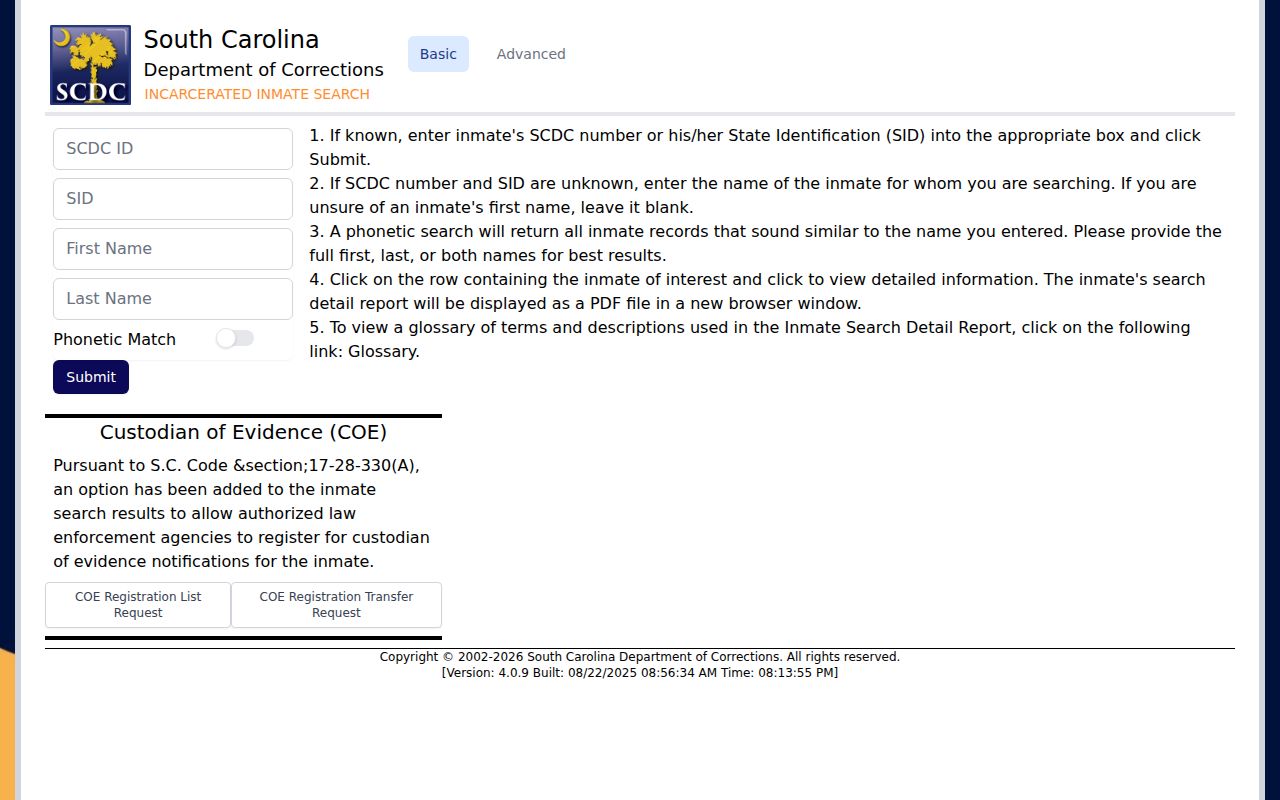
The image documents the state-prison route. SCDC’s own disclaimer says the current search excludes released people, county detainees, supervision cases, fugitives, and juveniles.
The broader Union County released inmate record process explains how the county, court, and historical SCDC records fit together after custody ends.
Note: Allow reasonable intake time after a county-to-SCDC transfer because the state current search reflects information as of the prior midnight.
SCDC Release Calculator for Union County
SCDC provides a separate release-date calculator. Its outputs are labeled Earliest Possible Parole Eligibility Date and Earliest Possible Release Date. Those labels matter. The calculator assumes maximum good time and work credits and describes an earliest possible scenario, not an official date for a sentenced individual.
Inputs include the offense, total sentence, incarcerated sentence, sentence date, jail credit, and whether terms run concurrently or consecutively. Concurrent terms run at the same time. Consecutive terms run one after another. A wrong choice can materially change the estimate. The tool should not be used for someone already sentenced, a Youthful Offender Act sentence, or a case with prior or later convictions that the model does not account for.
The official SCDC calculator disclaimer and inputs appear in the successful capture below.
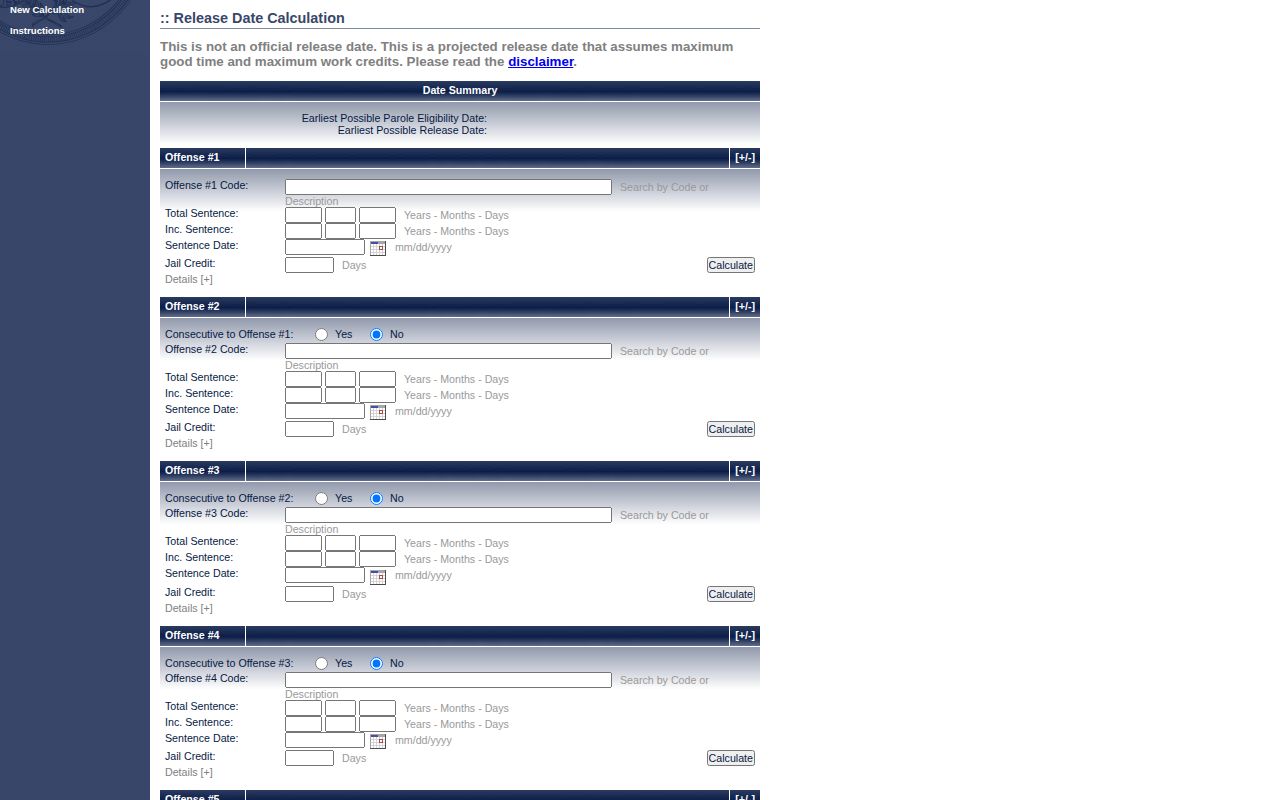
The disclaimer keeps an estimated earliest date from being confused with the Projected Release Date assigned to an actual current inmate record.
Questions about a sentenced person’s calculation go to the SCDC Inmate Records Office at 803-896-8531. That office, not the general calculator, can address the sentence data applied to an individual state record.
Union County Good-Time Release Rules
South Carolina’s credit rules depend on sentence classification. They do not support one simple percentage for every inmate. Code Section 24-13-210 provides 20 days of good-conduct credit per month served for a qualifying parole-eligible SCDC inmate and three days per month for a no-parole inmate. Credits can be forfeited, and consecutive terms are aggregated for the calculation.
Section 24-13-230 permits conditional productive-duty and education credits. For a parole-eligible inmate, the director may award up to one day for each two days, with combined work and education reductions capped at 180 days per year. For a no-parole inmate, the statute permits up to six days per month. The word “may” is important. Program participation, conduct, eligibility, and agency decisions mean these credits are not automatic.
Presentence jail credit also matters. Section 24-13-40 governs sentence commencement and credit for time spent jailed before sentence, with exceptions for time already credited to another sentence, some later crimes committed on bond, and revoked-bond situations. The sentencing and custody records must establish which days count.
- Good-conduct credit
- A statutory sentence credit tied to qualifying conduct and sentence class.
- Earned credit
- A conditional reduction linked to qualifying work or education.
- Jail credit
- Counted presentence custody time when allowed by law.
- Detainer
- A request or hold from another authority that can affect the next custody step.
Union County 85 Percent Rule
The 85 percent rule is limited to covered no-parole offenses. Section 24-13-100 generally defines a no-parole offense as a Class A, B, or C felony or a specified unclassified offense punishable by 20 or more years. Under Section 24-13-150, a person serving such an SCDC sentence cannot receive early release, discharge, or community supervision before serving at least 85 percent of the actual unsuspended term.
That floor is calculated without applying work, education, or good-conduct credits. Credits cannot reduce incarceration below it. The rule should not be applied to every South Carolina sentence, and a charge label alone is not enough to classify an individual term. The sentencing documents and SCDC record control.
Work release has a different threshold. Section 24-13-125 generally delays work-release eligibility for a no-parole offender until 80 percent of the actual unsuspended term, also calculated without credits. The 80 percent work-release threshold is not the same as the 85 percent custody floor.
After release from a qualifying no-parole term, Section 24-21-560 can place the person into community supervision for up to two continuous years. That phase is supervised release, not a reversal of the prison exit and not final discharge from all correctional control.
Why Union County Release Dates Change
A projected date changes when the facts used to compute it change. Some factors alter the sentence math. Others change what happens at the expected gate date without changing the court term itself. The record should identify which kind of event occurred.
| Factor | Possible effect | Best record to check |
|---|---|---|
| Good-time forfeiture | Moves the estimate later after a disciplinary loss | SCDC sentence and disciplinary calculation |
| Work or education credit rate | Changes the pace of an expected reduction | SCDC inmate record |
| Jail credit correction | Adds or removes counted presentence days | Court order and SCDC Inmate Records |
| Concurrent or consecutive terms | Changes whether terms overlap or stack | Sentencing sheet |
| New conviction or court correction | Changes the controlling sentence data | Court docket and corrected commitment |
| Detainer or outside hold | May cause transfer rather than community release | Custodian release record and receiving agency |
| Parole decision | May permit conditional release when legally eligible | Board hearing and result record |
Parole eligibility is not a guaranteed exit date. The Board can grant or deny parole, and its search results can lag. Likewise, a detainer can turn the end of SCDC or Union County custody into intake by another authority. The releasing agency’s record should state the receiving agency when a transfer occurs.
Note: A future date may remain unchanged while the destination changes, so ask whether another agency has lodged a hold.
Union County Sentence Date Checks
The Union County Detention Center and Sheriff Jeff Bailey's county office serve different records roles. The detention center houses county and city pretrial detainees, people serving General Sessions or summary sentences of 90 days or less, Family Court sentences, and up to 20 SCDC inmate workers. Those groups do not share one date method. A short county sentence depends on local custody and the court’s sentence. An SCDC worker remains a state inmate even while held at the county work facility.
Do not apply the SCDC web calculator mechanically to a person serving a short Union County sentence. Call the detention center at 864-429-2818 and request the county calculation or release record. Check the Union Public Index or Clerk of Court record for the sentence and any correction. Ask whether the person is held for SCDC, another county, ICE, the U.S. Marshals, or another agency.
A pretrial booking remains driven by bond and court action. Union Magistrates Court conducts bail-bond hearings twice daily, but no official clock times were published. Even after a court authorizes release, jail processing and other holds control the actual exit. The court order explains authority; the jail record supplies the physical release time.
Confirm Union County Actual Release
For an SCDC prisoner, use the separate Released Inmate Search after the expected date. Search a release-date range and the UNION county field, then read actual Release Date and Release Type together. The county field is an SCDC county or committing-county dimension, not proof that the person physically left custody in Union County or now lives there.
For a county detainee, request the Union booking and release record with admission date, release date and time, release authority or type, and receiving agency. Court records can explain bond or sentence authority but are not a jail door-time log. If a transfer occurred, continue with the receiving custodian.
A pending release alert can also be registered through the Union County VINELink release check. The alert is agency-specific and should be confirmed against the actual release or transfer record. A final chronology distinguishes projected date, release authorization, physical custody exit, transfer intake, supervision start, and later discharge.
Public Record Search
Sponsored Results